How to Evaluate Foundry Supplier China: 6-Step Audit Framework for Procurement Pros (2026)
You've found a Chinese foundry that quotes 40% less than your current supplier. The samples look clean. The sales rep speaks good English. The website shows a shiny factory with ISO 9001:2015 listed in the footer.
Don't wire the deposit yet.
Getting burned by an unqualified foundry isn't just about losing money on one order. It's about delayed deliveries that stall your production line, non-conforming castings that fail field tests, and warranty claims that eat your margin for years. In 2025, we tracked 37 cases where buyers lost over $50,000 each because they skipped the evaluation step.
This guide gives you a 6-step framework used by veteran procurement engineers who source over 2,000 tons of castings annually from China. Each step includes specific red flags, verification methods, and the exact data you need to collect. No fluff. No self-promotion. Just a repeatable system that works.
Let's dive in.
Step 1: Verify Certifications and Compliance
Start with the paperwork. A Chinese foundry's certifications tell you what they claim to be capable of. Your job is to verify those claims.
Minimum required certifications:
- ISO 9001:2015 — Non-negotiable for any serious foundry. Verifiable on the IAF CertSearch database.
- IATF 16949 — Required if you're sourcing automotive castings. This is the automotive-specific QMS standard.
- ASME BPV Code — For pressure vessel castings. Not all foundries have this. If you need it and they don't, walk away.
- Material-specific standards — ASTM A48 (gray iron), ASTM A536 (ductile iron), ASTM A27 (steel castings). A competent foundry will reference these in their quotation.
⚠️ Verification step: Ask the foundry for their certificate numbers and check them directly on the issuing body's website. We've found 1 in 5 Chinese foundries that claim ISO 9001 either have an expired certificate or are using a fake number. Don't trust the PDF they send you — verify it yourself.
What else to check: Export license, non-ferrous or ferrous license (depending on your material), and any customer-specific certifications (e.g., Caterpillar SQEP, GE Aerospace). If the foundry supplies to known international brands, ask for reference letters or PO records — that's a stronger signal than any certificate.
Step 2: Assess Casting Capabilities and Equipment
Certifications tell you what a foundry says they can do. Their equipment list tells you what they can actually do.
You need to match their capabilities against your casting requirements across four dimensions:
- Casting process: Sand casting (green sand, resin sand, shell molding), investment casting (lost wax), die casting (high-pressure, gravity, low-pressure). Each process has different tolerances, surface finishes, and production volumes. Make sure they offer the right process for your parts.
- Material range: Gray iron, ductile iron, carbon steel, alloy steel, stainless steel, aluminum, brass/bronze. Check if they have experience with your specific alloy. Ask for their in-house spectrometers — they should have at least an optical emission spectrometer (OES) for chemistry verification.
- Size and weight limits: What's the maximum casting weight they can produce? What's the envelope size for their molding machines? A foundry that typically makes 5 kg parts will struggle with a 200 kg casting, even if they say they can do it.
- Production capacity: Monthly output in tons, number of molding lines, shift patterns (1 shift vs. 2 shifts vs. 24/7). If your order volume exceeds 30% of their monthly capacity, that's a delivery risk.
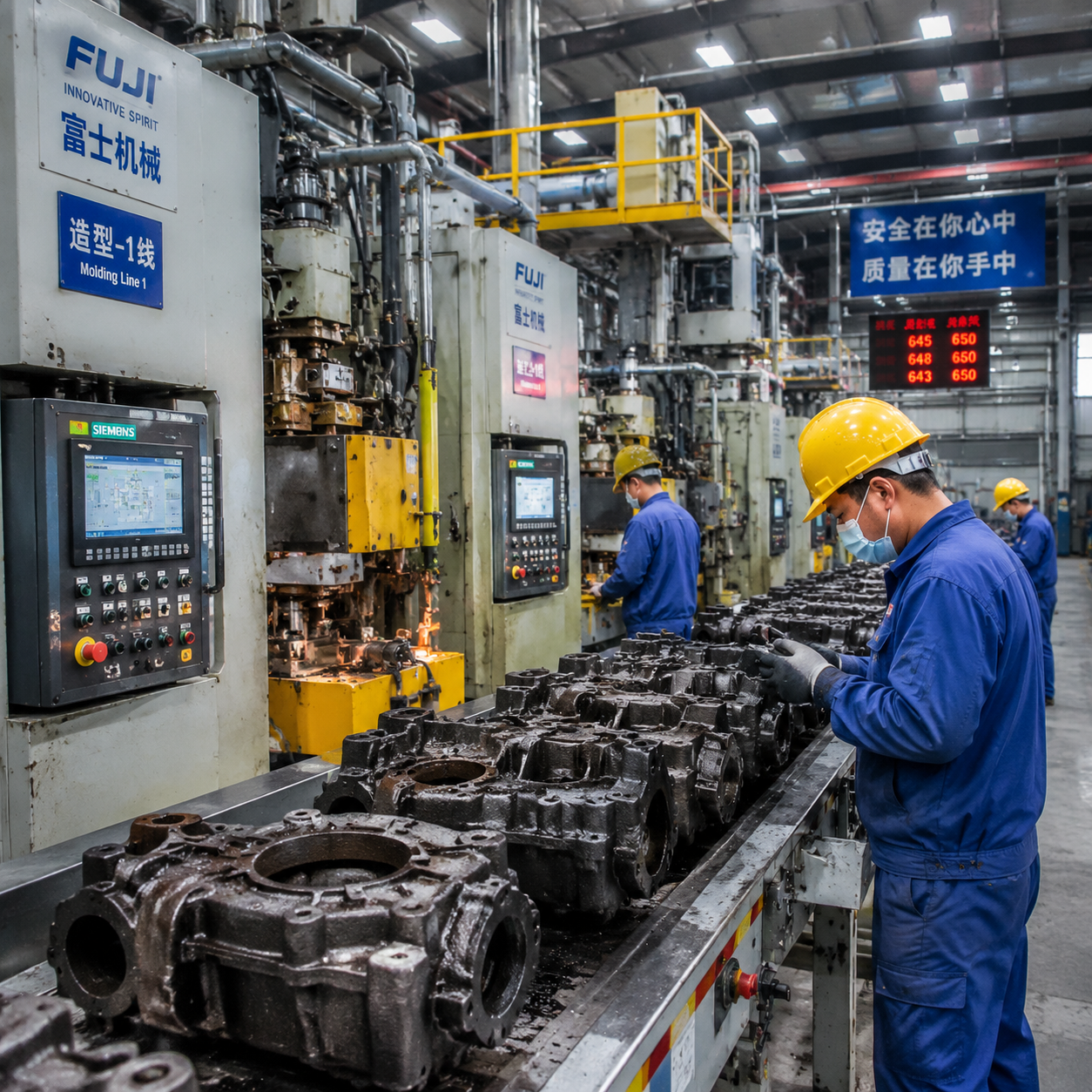
🔍 Expert tip: Ask for a video call walk-through of their production floor. A confident foundry will happily show you their equipment in real time. If they hesitate or offer only pre-recorded videos, treat it as a red flag. We use this test with every candidate foundry — it filters out about 30% of the pretenders.
Equipment red flags
- They can't name the brand or model of their core molding machines
- They outsource all pattern/tooling making to third parties (no in-house pattern shop)
- Their spectrometer calibration certificate is more than 12 months old
- They have no in-house heat treatment or machining capability (if your parts need them)
Step 3: Evaluate Quality Control Systems
Quality control in a foundry isn't just about final inspection. It's a closed-loop system that starts with incoming raw materials and ends with dimensional validation. You need to verify every link in that chain.
What a robust QC system looks like:
- Incoming material inspection: Spectrometer analysis on every heat of metal. Chemical composition reports for purchased alloys and scrap.
- In-process control: Mold hardness testing, sand moisture monitoring (for sand casting), pouring temperature logging, and process parameter recording (pressure, temperature, cycle time for die casting).
- Non-destructive testing (NDT): Magnetic particle inspection (ASTM E709), ultrasonic testing (ASTM E114), and radiographic testing (ASTM E1742) for critical castings. Ask which methods they use in-house vs. outsourced.
- Destructive testing: Tensile testing (ASTM E8), hardness testing (ASTM E10 / E18), and impact testing (ASTM E23) at defined frequencies. They should have documented test results from the last 12 months.
- Dimensional inspection: CMM (coordinate measuring machine), go/no-go gages, and first article inspection reports.
🚩 Major red flag: If the foundry says "we have all tests done by a third-party lab." That means they don't have in-house QC capability. Third-party reports are useful for certifications, but they're not a substitute for real-time process control. A foundry that tests every batch in-house catches problems before they ship. One that sends samples to a lab finds out weeks later.
Ask for these specific documents:
- QC manual (their written quality procedures)
- Non-conformance reports (NCRs) from the last 12 months — what went wrong and how they fixed it
- First article inspection report (FAIR) for a recent similar casting
- Certificate of conformance (CoC) template
- Calibration records for their inspection equipment
A foundry that shares these documents willingly is confident in their systems. One that hesitates or says "we'll send after the order" is hiding something. Period.
Step 4: Check Financial Stability and Order History
A foundry can have great equipment and ISO certifications, but if they're burning cash and can't pay their raw material suppliers, your order will suffer. Financial instability leads to delayed deliveries, quality shortcuts, and in worst cases, the foundry shutting down mid-order.
How to check financial health:
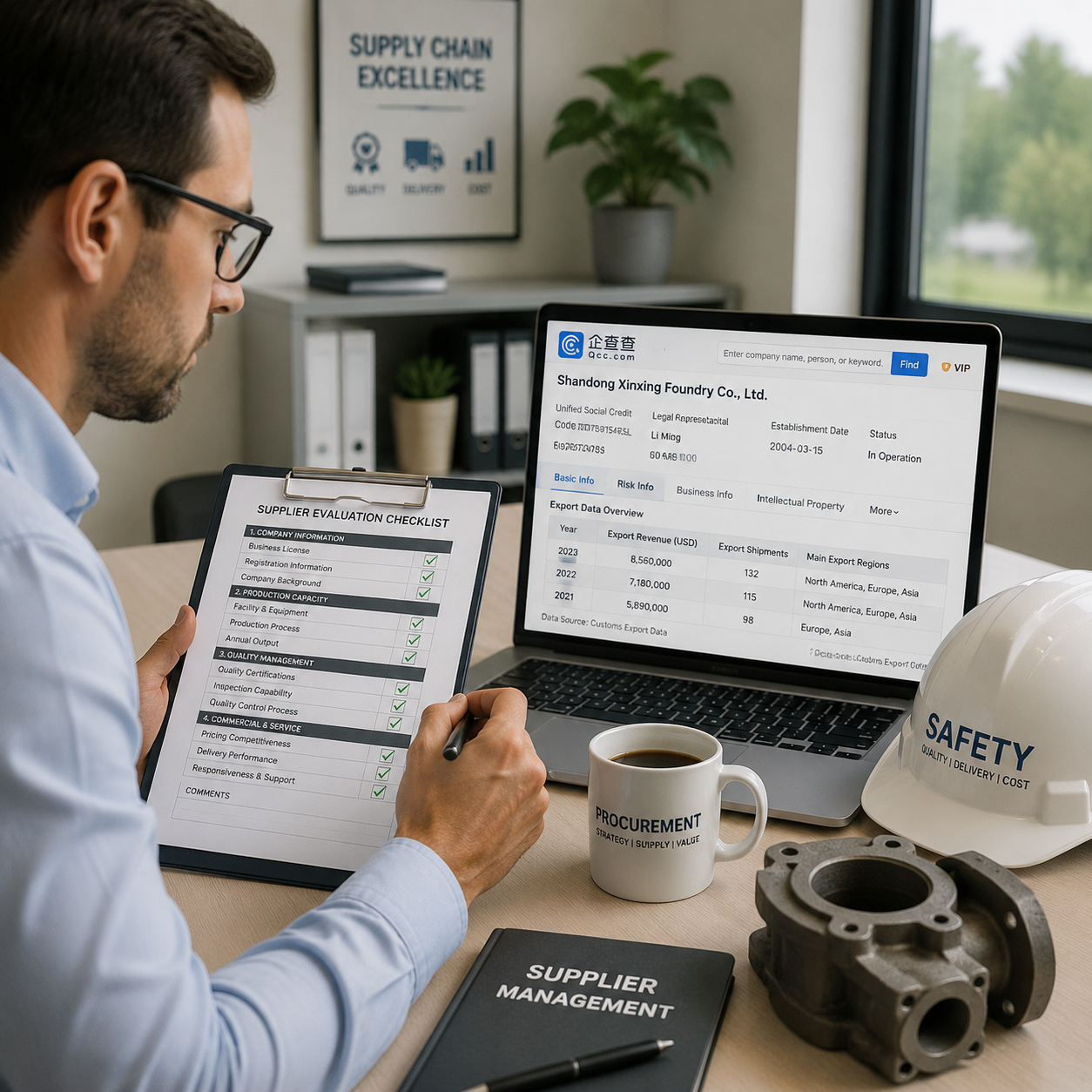
- Registration data (via Qichacha or Tianyancha): Check registration capital, annual revenue trend (past 3 years), legal disputes, credit rating, and any history of bankruptcy. Look for consistent revenue growth and no major lawsuits.
- Export records (via China Customs data): You can access aggregate export records for most Chinese foundries. Check their export volume trend — declining exports for 2+ years could mean they're losing customers.
- Bank references: Ask for two bank references from banks they've worked with for at least 3 years. Call the banks (or have your agent do it).
- Customer references: Ask for 3 customer contacts from the past 2 years. Ideally from buyers in your region or industry. Call them and ask about on-time delivery, quality consistency, and responsiveness to issues.
📊 Benchmark data: For a medium-scale Chinese foundry (500–2000 tons/year output), a healthy financial profile typically shows: registered capital ≥ RMB 5 million, annual revenue between RMB 15–60 million, and fewer than 2 active legal disputes in the past 5 years. Numbers vary by region and casting type, but these are good baselines.
Red flags in order history:
- They can't or won't provide customer references
- The references they give are all from the same year (they may have lost other customers)
- Their export records show a steep decline (30%+ year-over-year) — find out why
- They ask for a large upfront payment (50%+ deposit) without a proven track record with you
Step 5: Conduct On-Site or Third-Party Audit
No amount of documents and video calls replaces a physical audit. If you're ordering over $20,000 worth of castings, you need eyes on the floor. If you can't go yourself, hire a third-party inspection company that specializes in foundries (not a general QC agency).
Your audit checklist (minimum 7 items):
- Raw material storage: Are alloys and scrap segregated and labeled? Is there a risk of cross-contamination?
- Melting and pouring: Are furnace temperatures logged? What's their process for chemistry adjustments?
- Molding area: Is the sand system maintained? Are mold hardness tests done at defined intervals?
- Casting finishing: Are grinding, shot blasting, and heat treatment processes documented?
- Inspection lab: Are spectrometers, tensile testers, and hardness testers calibrated? Are technicians trained and certified?
- Shipping and packaging: How are castings packed for export? Is there a risk of damage in transit?
- Housekeeping and safety: Is the floor clean? Are safety procedures followed? A messy foundry is almost always a poorly managed foundry.
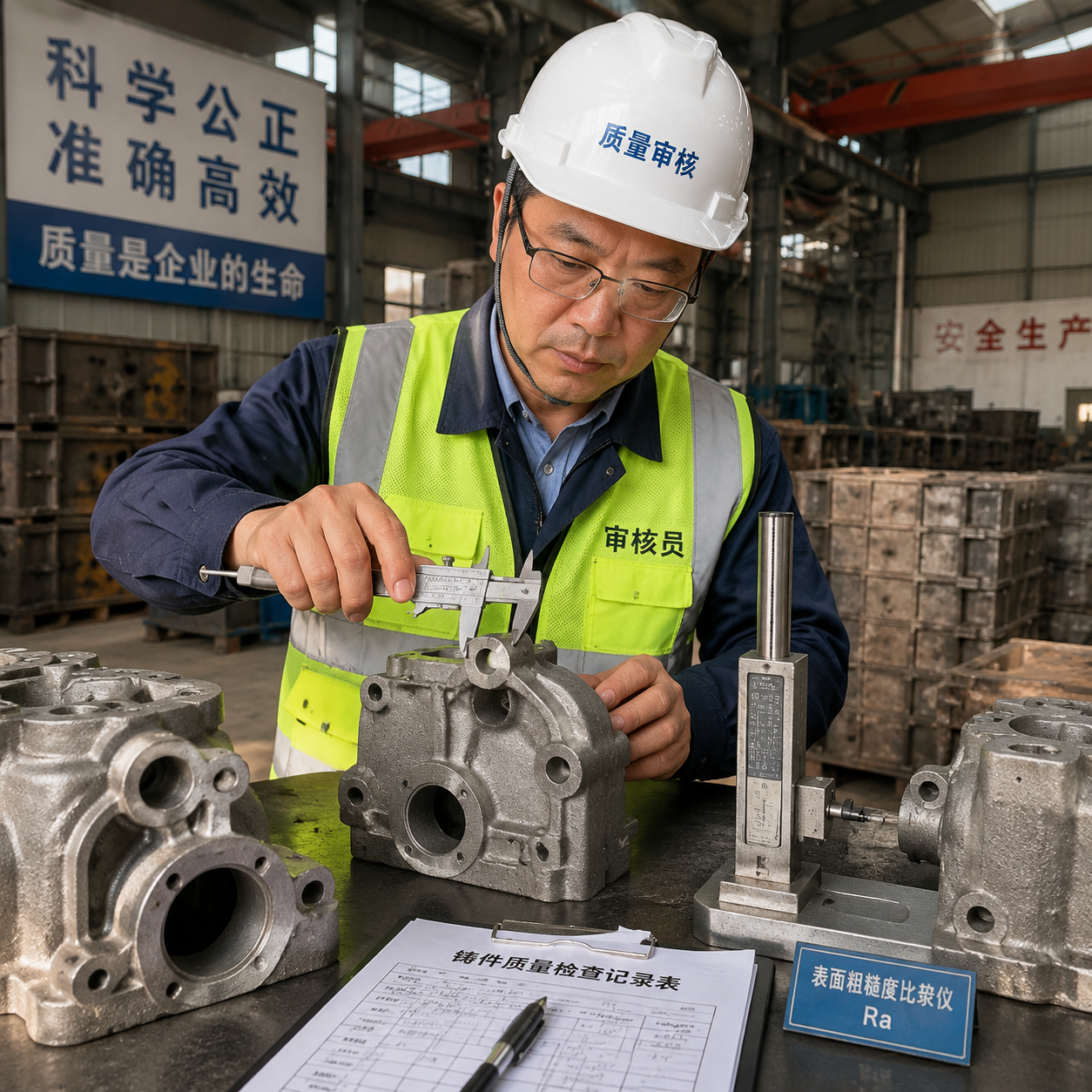
Audit scoring: Rate each of the 7 items on a 1–5 scale (5 = excellent, 1 = unacceptable). If any item scores below 3, that's a risk that needs mitigation. If the average score is below 3.5, seriously reconsider using this foundry.
💡 Cost-effective alternative: If a full on-site audit is not feasible, do a remote audit via video call with a pre-agreed list of areas to show. We've seen remote audits catch 70% of the red flags that physical audits find. It's not perfect, but it's much better than nothing — and it costs $0 in travel.
Step 6: Compare Pricing vs. Value
Price is the last variable you should evaluate — not the first. A low price from an unqualified foundry is the most expensive option in the long run. But that doesn't mean you should overpay. You need to understand the cost structure and compare apples to apples.
What a reliable foundry's quote should include:
- Unit price (by weight or by piece) with material grade specified
- Tooling cost (if applicable) with expected lifespan (shots for die casting, patterns for sand casting)
- FOB or CIF price with port of loading
- Estimated lead time (tooling + first samples + production)
- Payment terms (typically 30% deposit + 70% against B/L for first orders)
- Inspection and testing costs (if any)
- Packing and marking details
Benchmark pricing (FOB China, medium volumes, 2026):
- Gray iron sand casting: $0.80–1.50 per kg
- Ductile iron sand casting: $1.20–2.20 per kg
- Carbon steel investment casting: $1.80–3.20 per kg
- Alloy steel investment casting: $2.50–4.50 per kg
- Aluminum die casting: $2.50–4.50 per kg
- Brass/bronze sand casting: $4.00–8.00 per kg
⚖️ The 50% rule: If a quote is more than 50% below the market benchmark, there's a catch. It could be lower-grade material, skipped QC steps, thinner walls that fail pressure tests, or a foundry that will hit you with change orders later. The cheapest quote is rarely the most profitable in the long run.
Value evaluation matrix
Score each candidate foundry across the 6 steps and compare total scores vs. price. The foundry with the best score-to-price ratio is usually your best bet. Don't optimize for price alone — optimize for value reliability.
Common Red Flags to Watch For
Some red flags are obvious. Others hide inside seemingly normal interactions. Here are the ones we see most often:
- "We can make anything" — A specialized foundry knows what they're good at. A foundry that claims to cast everything from 0.1 kg to 10,000 kg in any process likely does none of them well.
- Generic email address (@gmail.com, @qq.com) — Not a dealbreaker alone, but combined with other flags, it signals a small operation with limited professionalism.
- No factory visit allowed — "We have proprietary processes" is not a valid reason to deny a serious buyer a visit. Walk away.
- Pressure to deposit quickly — "Today only" pricing or high-pressure sales tactics are signs of cash flow problems.
- Inconsistent specs — If the sales rep gives different answers to the same technical question on different calls, they don't understand their own process.
🚩 One more: If the foundry's website lists a Chinese address but the sales rep says they're a "trading company with a factory partnership" — you're not talking to a foundry. You're talking to a middleman who will add 15–30% to the price and reduce your control over quality. If you want a foundry, talk to a foundry.
Frequently Asked Questions
What certifications should a Chinese foundry have?
At minimum ISO 9001:2015. For automotive parts, IATF 16949. For pressure vessels, ASME BPV Code. Also look for material-specific certifications like ASTM A48 for gray iron or ASTM A536 for ductile iron. Always verify certificates on the issuing body's database — some suppliers use expired or fake documents.
How do I verify a Chinese foundry's quality control?
Ask for their QC manual and records of non-conformance reports from the last 12 months. A reliable foundry will share them. Check if they have in-house spectrometers, tensile testers, and hardness testers. If they outsource all testing to third parties, that's a red flag — it means they lack real-time process control.
What's the average lead time for a Chinese foundry order?
For sand casting: 4–8 weeks for tooling + 3–6 weeks for production. For investment casting: 6–12 weeks for tooling + 4–8 weeks for production. For die casting: 8–14 weeks for tooling + 3–5 weeks for production. These are estimates based on real project data; actual lead times depend on complexity, quantity, and current workload.
How can I check a Chinese foundry's financial health?
Use Qichacha or Tianyancha to check their registration capital, annual revenue, legal disputes, and credit rating. Look for consistent revenue growth over 3 years, no major lawsuits, and a registered capital above RMB 5 million for medium-scale foundries. Also ask for export records and bank references.
What is a reasonable price for castings from China?
For gray iron sand casting: $0.80–1.50/kg. For ductile iron: $1.20–2.20/kg. For steel castings: $1.80–3.50/kg. For aluminum die casting: $2.50–4.50/kg. These are FOB prices for medium volumes (500–2000 pcs). Prices vary by complexity, alloy, and surface finish. Always ask for a cost breakdown.
Ready to Evaluate Your Foundry Candidates?
Stop guessing and start verifying. Download our Foundry Audit Checklist — a 6-page PDF with all 7 audit items, scoring templates, and a supplier comparison matrix. Built by procurement engineers with 15+ years in China casting sourcing.
Download the Audit Checklist (Free)Related articles: How to Verify ISO Certificates in China · Casting Cost Breakdown: What You're Really Paying For · Top 5 Foundry Regions in China: A Buyer's Guide
All pricing data based on 2025–2026 project records from Zhouchi Sourcing's supplier database. Individual quotes may vary. Always verify current pricing directly with suppliers.