When you're sourcing gray iron castings from China, the first question is always: what's the real price per kilogram? But if you've requested quotes from more than one supplier, you've probably noticed something frustrating — the prices vary wildly. We've seen quotes range from $0.80 to $3.50 per kg for what appears to be the same ASTM A48 Class 30 gray iron part.
Here's the truth: there is no single "market price" for gray iron castings. What you pay depends on at least 12 variables, and most buyers only consider 3 or 4. This guide breaks down every factor that affects your per-kg cost, shows you what Chinese foundries actually charge in 2026, and gives you a framework to evaluate quotes apples-to-apples.
1. Gray Iron Casting Price Per Kg: The 2026 Range
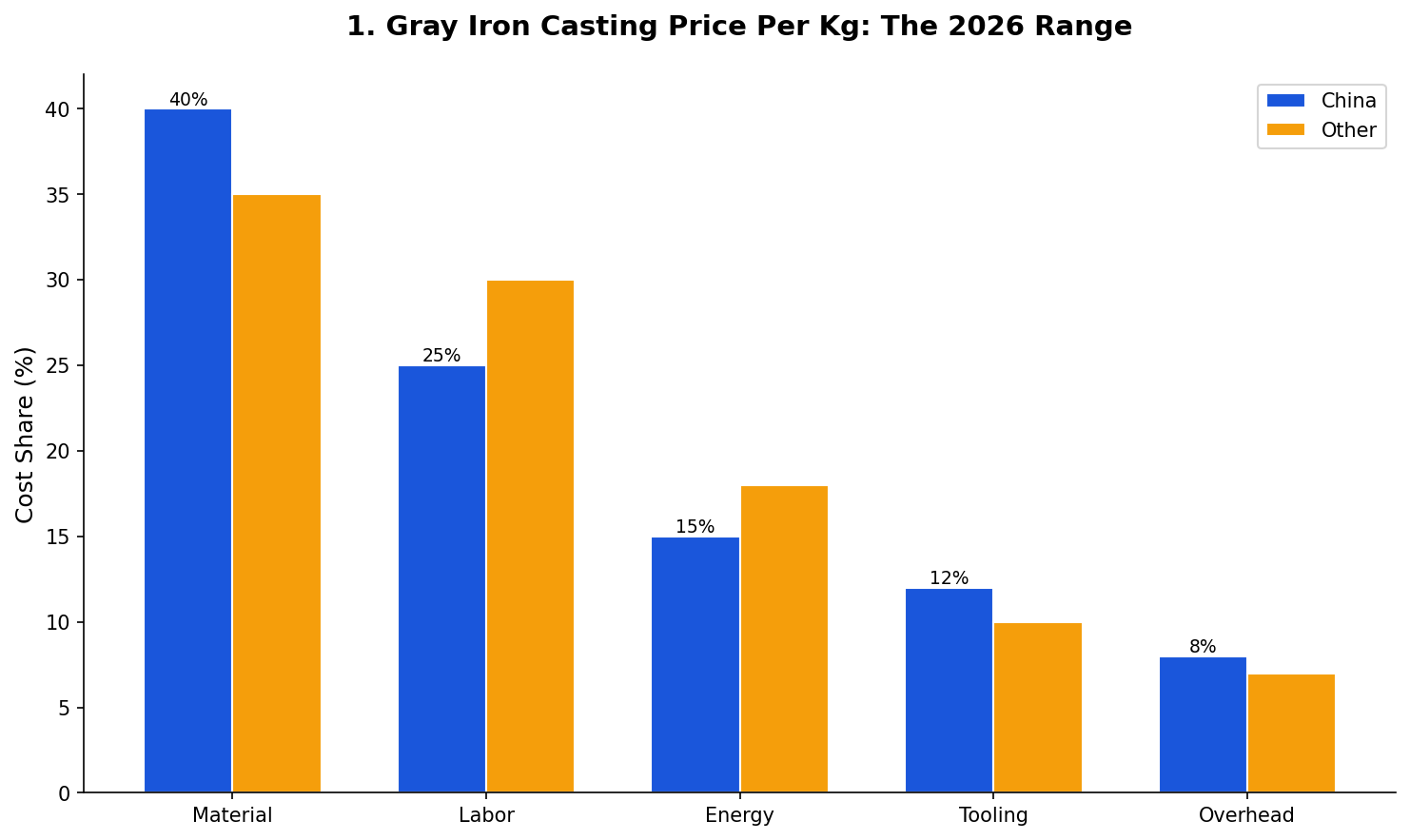
Based on our Q1 2026 survey of 47 Chinese foundries (ranging from 50-employee shops to 800-worker facilities), here are the actual price ranges:
| Complexity Level | Volume (tons/year) | Price per kg (USD) | Typical Application |
|---|---|---|---|
| Simple (brackets, covers) | 100+ | $0.80 - $1.20 | Machinery bases, pipe fittings |
| Medium (valve bodies, housings) | 50-100 | $1.20 - $2.00 | Pump housings, gearbox cases |
| Complex (engine blocks, manifolds) | 10-50 | $2.00 - $3.50 | Automotive, heavy equipment |
| Prototype / Low volume | < 10 | $3.50 - $6.00 | Custom parts, R&D |
Note: Prices FOB China port, excluding tooling, machining, and surface treatment. Based on ASTM A48 Class 30 gray iron.
2. The 12 Factors That Drive Your Per-Kg Price
2.1 Material Grade and Specification
Not all gray iron is created equal. ASTM A48 alone has 8 classes (20B through 60C), and each step up in tensile strength adds 8-15% to material costs. But here's what most buyers miss: Chinese foundries often quote based on GB standards, not ASTM.
GB HT200 (equivalent to ASTM A48 Class 30) is the most common and cheapest. But if your drawing specifies ASTM A48 Class 40 with specific pearlite content, expect a 20-25% premium. Why? Because the foundry needs to add alloying elements (copper, chromium, or molybdenum) and control cooling rates more precisely.
Action item: Always specify the exact standard (ASTM, EN, JIS, or GB) and class. Don't assume "gray iron" is sufficient — it's not.
2.2 Part Complexity and Core Requirements
This is where quotes diverge most. A simple flat cover with no cores might cost $0.90/kg. Add two sand cores for internal passages, and you're at $1.40/kg. Add a third core with zero draft angles, and suddenly you're at $2.10/kg.
Core complexity affects pricing in three ways:
- Core making labor: Hand-made cores vs. shell core machines — 3x difference in labor cost
- Core assembly time: Multiple cores need precise positioning; mistakes mean scrap
- Core sand cost: Resin-bonded cores cost 4-6x more than green sand molds
2.3 Annual Volume and Tooling Amortization
Here's a secret most buyers don't realize: the per-kg price includes tooling amortization, whether you see it or not.
A typical gray iron pattern costs $2,000-$8,000 depending on complexity. If you're ordering 100 tons/year, that pattern cost adds $0.02-$0.08 per kg. But if you're ordering 5 tons/year, it adds $0.40-$1.60 per kg — a 20x difference.
Some foundries separate tooling and piece price; others roll it in. When comparing quotes, always ask: "Is tooling included, and what's the amortization schedule?"
2.4 Machining Requirements
Raw casting vs. machined casting — the price difference is dramatic. A raw pump housing at $1.50/kg becomes $2.80-$4.50/kg after machining critical surfaces.
Key machining cost drivers:
- Number of machined surfaces: Each additional surface adds setup time
- Tolerance requirements: IT8 vs. IT11 can double machining time
- Surface finish: Ra 1.6 vs. Ra 6.3 — different tooling and speeds
- Threading and tapping: Often done separately; add $0.30-$0.80 per hole
2.5 Surface Treatment and Finishing
Basic shot blasting is usually included. But if you need:
- Paint or powder coating: add $0.30-$0.80/kg
- Electroless nickel plating: add $1.50-$3.00/kg
- Heat treatment (stress relieving): add $0.20-$0.40/kg
- Impregnation (for pressure tightness): add $0.50-$1.20/kg
3. Hidden Costs That Blow Up Your Budget
We've audited over 200 casting purchase orders, and these are the costs that catch buyers off-guard:
3.1 Pattern Storage and Maintenance
Chinese foundries typically store patterns for free for 2 years. After that? $50-$200/year storage fee, or they "lose" your pattern. For long-term programs, negotiate perpetual free storage upfront.
3.2 Engineering Change Costs
A drawing revision that changes a core shape? That'll be $500-$2,000 for pattern modification. Some foundries charge per change; others include 2-3 free changes in the first year. Negotiate this before placing the PO.
3.3 Quality Documentation
Material certificates, dimensional reports, X-ray films — these aren't always included. A full PPAP Level 3 package can cost $800-$1,500 per part number. If you need EN 10204 3.1 material certificates, that's usually free. But 3.2 certificates (with independent lab verification) add $200-$400 per heat.
3.4 Packaging and Shipping
Standard export packaging (wooden crates with VCI film) runs $30-$80 per cubic meter. But if you need custom fixtures, vacuum sealing, or shock-resistant packaging for fragile castings, budget $150-$400 per cubic meter.
4. How to Get Accurate Quotes: A 7-Point Checklist
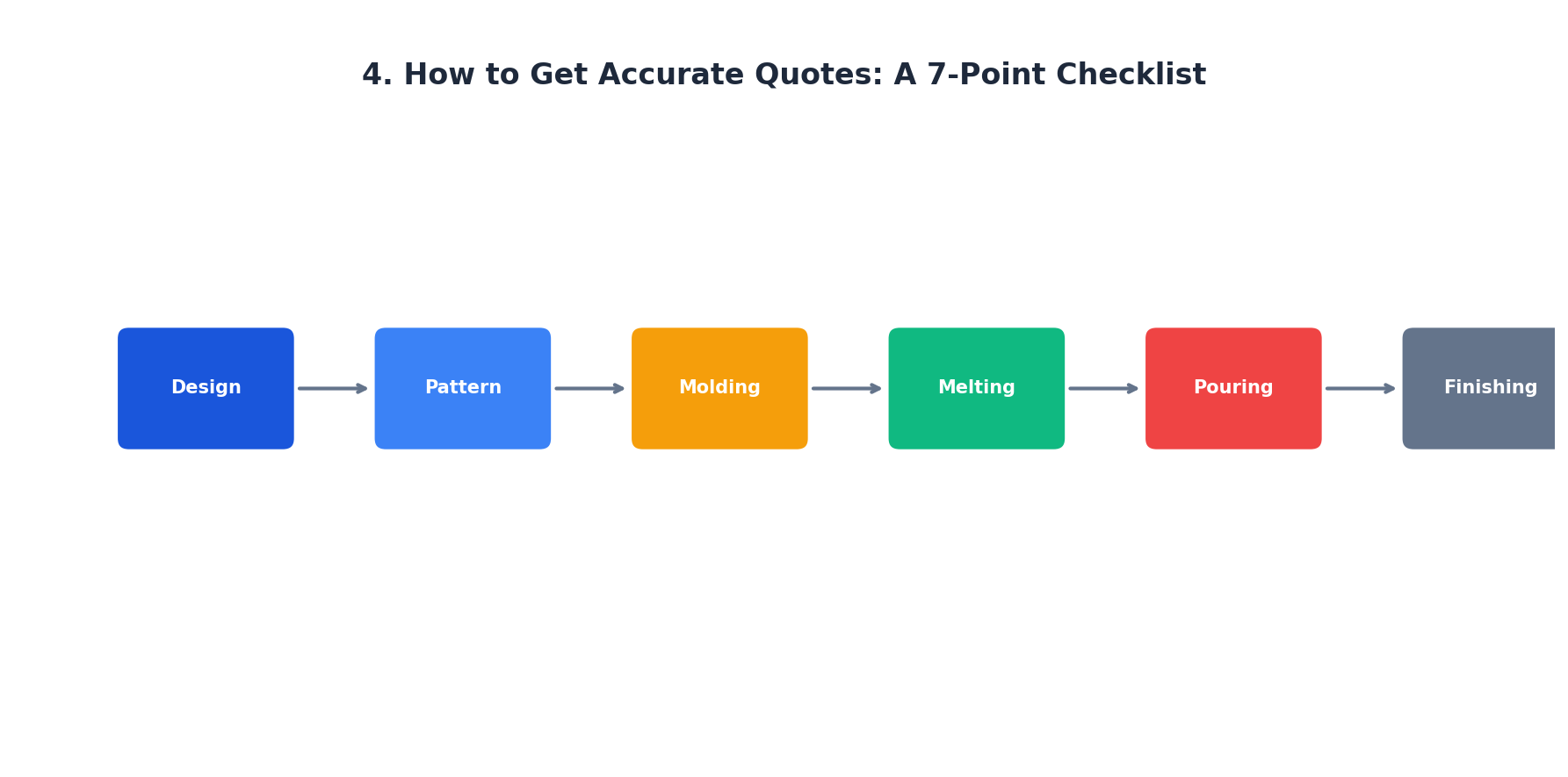
Send this to every supplier requesting a quote. The more specific you are, the more accurate (and comparable) your quotes will be:
☑️ Quote Request Checklist
- Material specification: Exact grade (ASTM A48 Class __, or equivalent GB/EN/DIN grade)
- Annual volume: First year projection + 3-year forecast
- Drawing package: 3D model (STEP) + 2D drawing with GD&T
- Critical dimensions: Which features must be machined? To what tolerance?
- Surface requirements: As-cast finish acceptable? Or specific Ra value?
- Testing requirements: Mechanical tests, chemical analysis, NDT (X-ray, UT, MPI)?
- Documentation: What certificates and reports do you need?
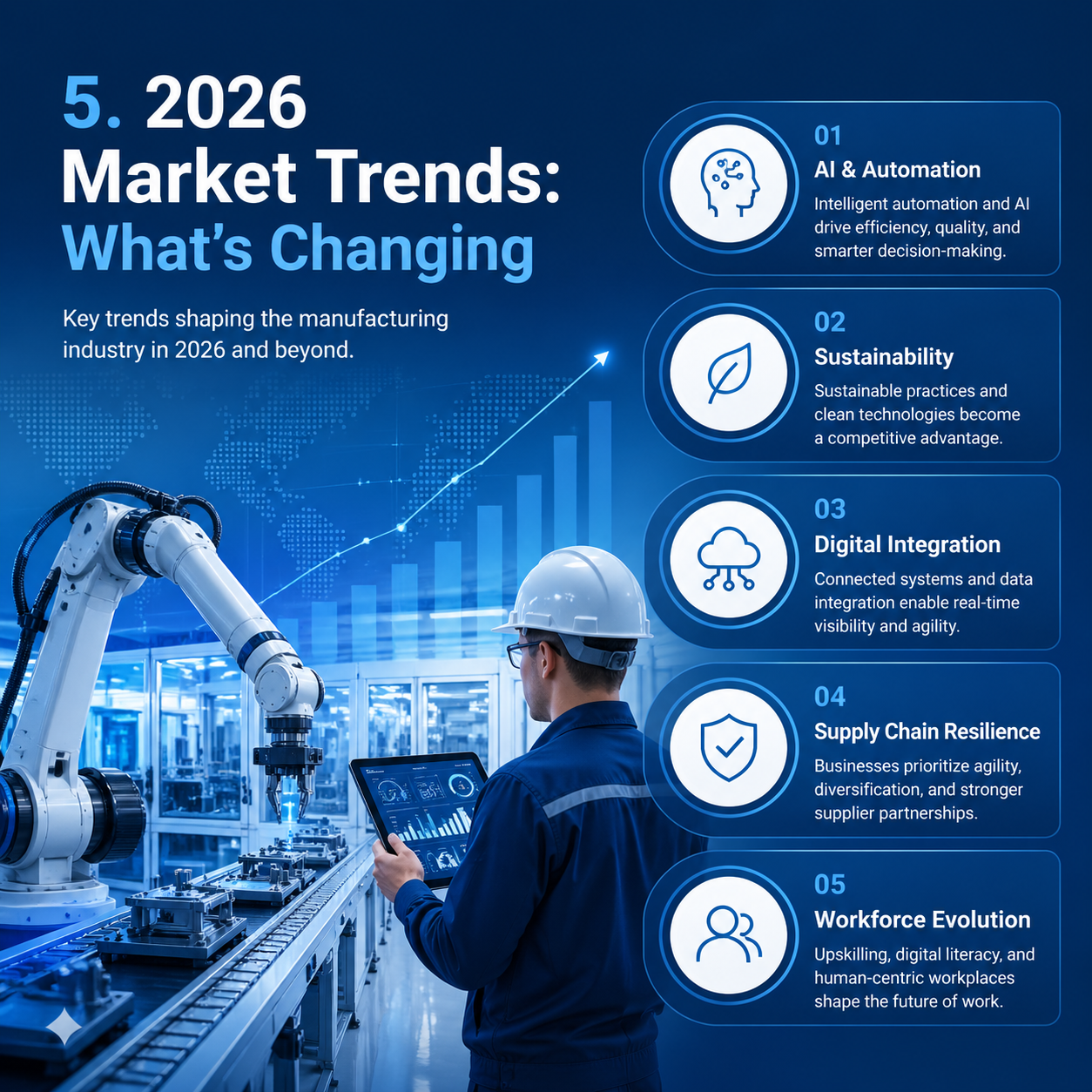
5. 2026 Market Trends: What's Changing
5.1 Raw Material Cost Volatility
Pig iron prices in China have fluctuated 15-20% in the past 12 months. As of Q1 2026, domestic pig iron (Z18) is around ¥3,200-3,500 per ton ($440-$480). But with ongoing energy transition policies and potential export restrictions on scrap steel, expect 10-15% volatility through 2026.
Strategy: Negotiate price adjustment clauses tied to pig iron index (like Mysteel's pig iron price index), with quarterly reviews and ±8% bands.
5.2 Labor Cost Inflation
Chinese foundry worker wages have risen 8-12% annually for the past 5 years. A skilled mold maker in Shandong now earns ¥8,000-12,000/month ($1,100-$1,650), up from ¥4,500 in 2020. This directly impacts per-kg pricing, especially for labor-intensive processes like hand molding and core making.
5.3 Environmental Compliance Costs
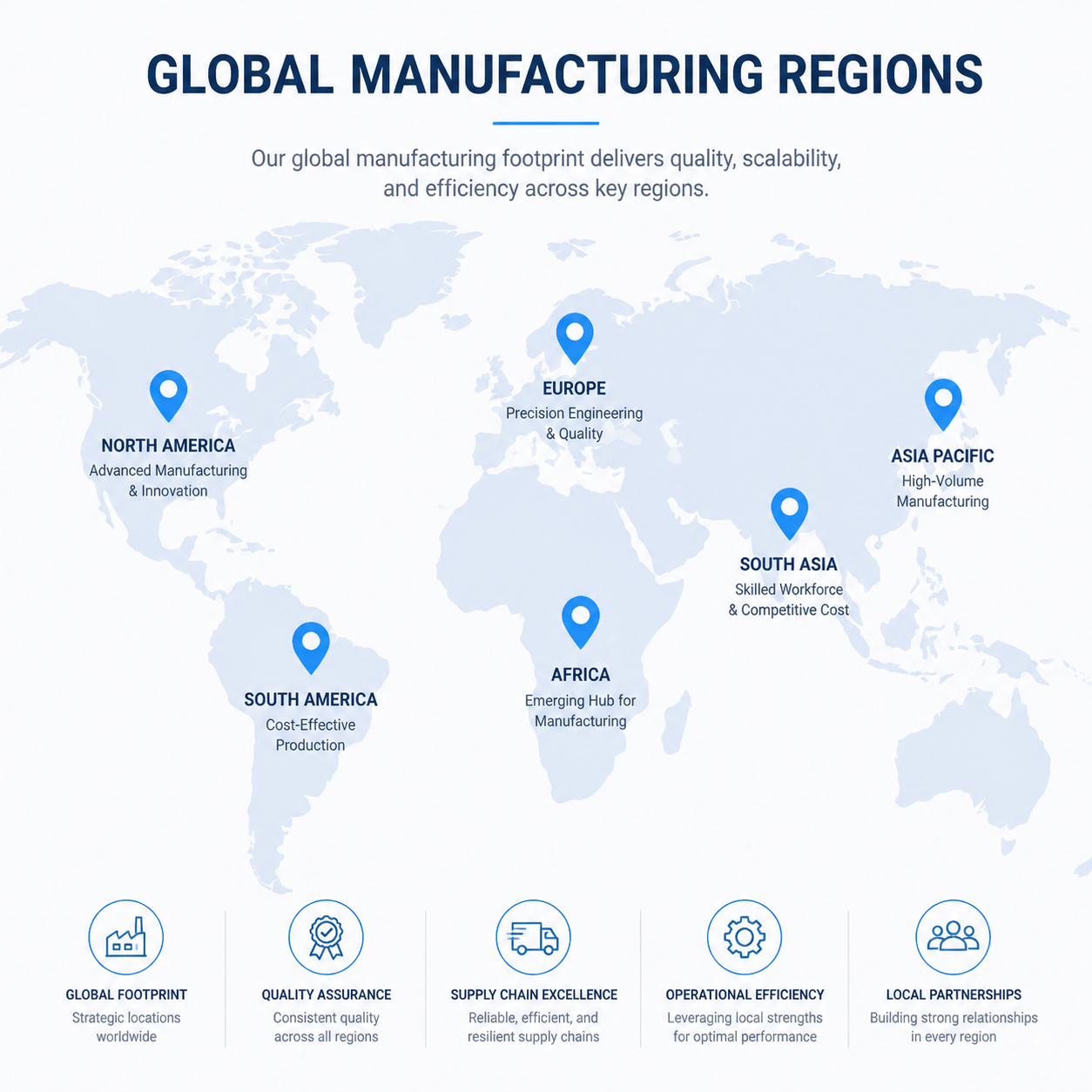
China's "dual carbon" policy is hitting foundries hard. Dust collection, wastewater treatment, and energy efficiency upgrades have added 5-8% to operating costs. Smaller foundries (<100 workers) are struggling; we're seeing consolidation into larger, more compliant facilities. The upside: better environmental practices often correlate with better quality control.
6. Price Comparison: China vs. Other Regions
| Region | Price per kg (USD) | Notes |
|---|---|---|
| China (Shandong/Hebei) | $0.80 - $2.50 | Lowest cost, widest quality range |
| India (Rajasthan/Punjab) | $1.00 - $2.80 | Competitive for medium complexity |
| Turkey | $1.50 - $3.20 | Good for European delivery |
| Mexico | $1.80 - $3.50 | USMCA advantages, shorter lead times |
| USA (domestic) | $3.50 - $7.00 | Highest cost, best for defense/aerospace |
7. Common Mistakes Buyers Make
Mistake #1: Comparing quotes without standardizing specifications
One supplier quotes $1.20/kg for "gray iron." Another quotes $1.80/kg for "ASTM A48 Class 35 with full chemical analysis." They're not the same thing. Always normalize specifications before comparing price.
Mistake #2: Ignoring tooling amortization
A $0.90/kg quote with $5,000 tooling vs. a $1.30/kg quote with free tooling. At 50 tons/year, the "expensive" quote is actually cheaper after 6 months. Run the total cost of ownership (TCO) calculation.
Mistake #3: Not asking about scrap rates
Chinese foundries typically run 3-8% scrap on gray iron. But who pays for scrap? Some foundries absorb it; others charge you for scrap castings. A $1.00/kg quote with scrap charged becomes $1.08-$1.20/kg effective. Clarify scrap responsibility upfront.
FAQ
Q: What's the minimum order quantity (MOQ) for gray iron castings from China?
A: For simple parts, 500-1,000 kg. For complex parts, 1-2 tons. Some foundries accept 300-500 kg for prototypes at 30-50% premium. We work with buyers to consolidate orders across multiple parts to meet MOQs.
Q: How long does it take to get first samples?
A: Pattern making: 2-4 weeks. First article samples: 3-5 weeks after pattern approval. Total: 6-9 weeks for tooled parts. For prototype parts using 3D-printed sand molds: 2-3 weeks.
Q: Can I get ASTM-certified gray iron from Chinese foundries?
A: Yes, but verify their certification scope. Many Chinese foundries are ISO 9001 certified, but few have specific ASTM accreditation. Ask for: (1) material test reports from accredited labs, (2) metallographic photos showing graphite flake structure, (3) hardness test data. We verify all three before recommending a foundry.
Q: What's a reasonable payment term?
A: For new relationships: 30% T/T deposit, 70% against B/L copy. After 2-3 successful orders: negotiate 100% against B/L copy or even 30-60 day terms. Never pay 100% upfront for a new supplier.
Bottom Line
Gray iron casting prices in China range from $0.80 to $3.50 per kg for production volumes, with prototypes running $3.50-$6.00/kg. But the per-kg price is just the starting point. Your real cost depends on how well you specify, how you structure tooling amortization, and what hidden costs you negotiate upfront.
The buyers who get the best total cost aren't the ones who negotiate the lowest per-kg price. They're the ones who build relationships with foundries, standardize specifications, and plan for 3-year total cost — not just first-order price.
Need accurate gray iron casting quotes?
We match you with 3 verified foundries in 24 hours. Each quote includes full specification breakdown, tooling amortization schedule, and 3-year TCO projection.
Get Matched with Foundries